This is one where people are of two minds I think. Even my own splits in two here. Can a junkyard bear a historical meaning? And if yes, should it be cleared due to environmental protection?
Well, the story is this: In the years from 1933 until 1975, when his son took over his business, Walter Messerli dealt second hand spares. He parked the remaining car wrecks in his backyard, where they are still today. Now a local curt decided that the area has to be cleared because of pollution. Now there’s a pool forming to save this ‚Historical Junkyard‚.
You know, I want cars with combustion engines abolished. I would stand in the first row! But when I see this pictures – there’s something intriguing and I’m sort of glad I don’t have to make the decision. Click ‚continue reading‘ to see more pics and tell me what you think.
What would happen if every blog published on the same topic on the same day? Blog Action Day aims to find out. On October 15 2007, bloggers around the world unite for one day to change the conversation. To find out more and get involved visit blogactionday.org.
Please contribute – for the next few years we’ll have only this one spacestation to live on… 😉
«…the WHO’s findings suggest that long-term exposure to traffic noise may account for 3 per cent of deaths from ischaemic heart disease in Europe – typically heart attacks.»
In Europa alone probably half a million lifeyears are lost anually.
Nothing new are the facts that chronical niose pollution cause sleep disorder, hardness of hearing and learning disorders.
But really interesting is this:
A Swedish survey in Munich has shown a 25 % advancement of childrens long-term memory in th area of the airport Riem, after it was closed. Just impressive is the fact of a memory decline in the same degree in the area of the new Munich airport since it started operation.
So, what do we learn? Wearing ear muffs should be obligatory… 😐
«The greatest shortcoming of the human race is our inability to understand the exponential function.»
Watch this dissertation from Dr. Albert A. Bartlett, professor emeritus of physics at the university of Boulder, Colorado (8 parts, each approx. 9 min):
Mankind is growing with approx. 1.6 percent a year. This means, in 780 years we’ll have an one-squaremeter-society: on every squaremeter land is one person living. And in 2500 years mankind will weigh the same as the whole earth (dear Albert is a joker for shure).
Or think of bacteria living in a bottle. It’s eleven o’clock. They double their volume once a minute. What time is it, when they realize that the bottle is half full and they’re getting a place problem? Right, it’s exact 11:59. If they become aware of the fact when the bottle is one eighth full? It’s 11:57. Ok, they start a big search now and can find 3 more bottles by the time when the first is one fourth full, witch gives an amazing amount of space: 16 times the room they use now! Problem solved, you think? Wait until 12:02…
Click above – this is the most important video you’ll ever see! Find out why it seems that most politicians, economists and even scientists are unable to do simple math we all did back in school.
And while you are at it, asking yourselt why we should act today to save our tomorrow, have a quick look at this video (9 min).
If you thought it would be nice to have mediterranean temperatures in middle Europe by two more degrees Celsius in 2025, you must know that there is a good chance we’d have an increase of four degrees that year. And with it the dryness of nord Africa.
You ask why? Particulate matter might decrease the effect of greenhouse gases by its half, Nowadays, with all the particle filters, we’ll eventually get a nice burn in the future – simple, isn’t it?
Watch this BBC-documentation on YouTube and spread the word:
Wer dachte, es wäre hübsch, in Mitteleuropa Mittelmeerklima zu haben, indem es 2 Grad wärmer wird, muss damit rechnen, dass es bis dann 4 Grad wärmer geworden ist. Und damit hier so trocken wie in Nordafrika.
Wie das gehen soll? Feinstaub in der Atmosphäre dürfte den Effekt der Treibhausgase um die Hälfte dämpfen. Mit den heutigen Partikelfiltern werden wir uns vielleicht einen netten Sonnenbrand einfangen.
Take a listen from this mp3-file (Baul Melody in 8 beats, 8/4):
To not stop playback surf in another tab/window!
Though it’s Indian Light Classical, it’s a master piece. This indian folk melody from the bengali Baul tradition is sweetly interpreted by Nikhil Banerjee (sitar) and Anindio Chatterjee (tabla) and I listened to it a minimum of 125 thousand times. Both are masters on their instruments and I especially suggest to listen to the little enrichments Nikhil gives to each note and the flow of the melody. He is just amazing!
If you never heard Indian Classical Music, this may open a new world for you. Indian Music is basically modal and based on one scale. Here is the seventh, the minor seventh and even the minor second in the scale at one point – so your listening habit may get stressed a bit. But belive me: You will love this! This is sugar.
If you like some more information about Classical Indian Music, you may start on Wikipedia.
Since I didn’t got inspired by something spectacular, I post here some links to little games thar you can play online. Some requires plugins like Shockwave, which you may have to install or update to make fun of it.
The first one is Bubble Shooter. In classical manner you’ll have to hit colored bubbles with another one you shoot. If there are more than three in the same color, they’ll disappear. The goal is to clean the bubbles off the field. Beware: Danger of habit formation!
One more is Gold Strike. You’ll be a miner who’s diggin‘ to some Banjosounds. The game principle is somewhat like Bubbles, but with a time limit and the bricks disappear, if there are more than two of the same type neighboring. It’s fun, but the game seems somewhat unfinished…
For a limitet time (until you’ve found the best strategy) is Snow Storm. Free the parking area with your snow plug. The graphics are very nicely done.
Have fun with these and let me know which you like most. On http://www.playit.ch you can find tons of games – most are some kind of stupid… you know 😉 . Also, please post in the comments if you know some good sites for a short break.
Today was a beautiful day and I was out by the river the first time this year with my Lapsteel playing. Looking at the water, this old movie «Power of ten» (YouTube video, 9 min.) from 1977 came to my mind. Read the details on wikipedia.
Well, this is now 30 years old, so I did some googling and found some more interesting, newer things. First, there’s a newer version of something similar: the Cosmic Voyage (YouTube, 4 min.) from 1996. This is unfortunately only the part of the journey similar to the former Power of Ten, I couldn’t find the whole movie, which is also described on Wikipedia.
Here’s also a slideshow-version from this idea to show the cosmos. I found even a version from the famous Simpsons animation series 🙂 .
There’s also a very interesting dissertation from astrophysicist Mike Norman on Google video (56 min). He takes you on an unprecedented journey across space and time to witness the formation of galaxies and cosmic structure as well as the formation of one of the first stars to shine in the universe.
His dissertation features also this by far the best animated virtual journey (YouTube, ca. 4 min.), calculated with accurate data from the actual cosmic science. So it’s up to date with data and computer rendering technique. Here are some screenshots (click for bigger versions, threy’re the best resolution I could get):
The journey will start at our solar system and the first impressing step is the Orion Nebula (right), 1000 light-years away, with the Horsehead Nebula (middle) in the background.
We then turn around to see a fictive picture of our own home galaxy, the Milkyway. Fictive because we still cannot shoot a picture of our galaxy… 😉 .
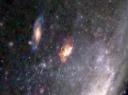
Then we will pass through the galaxy M-33 (right) towards the giant Andromeda galaxy with the blue outskirts (top left). In the middle another star forming Nebula in M-33, like the Orion Nebula, but much larger. We’re about 1 million light-years away from home.
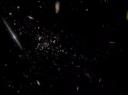
What looks like a couple of stars is actually the Virgo Cluster, about 28 mio light-years away, our local cluster of galaxies. Each white dot is a whole galaxy and the destination of this animated journey.
So, finally, if you look at the sky next time, try to imagine the 28 million light-years distance to our nearest galaxy cluster, which is only one of all them out there…
Just have a look at this picture I’ve found today. Isn’t it great? Although I’m not shure how well the pope is feeling. Anyway, the buddhist monk seems having a great time watching the others find a way to be tolerant… 🙂 !
You can download the original pdf here (link is dead). The campaign «week of the religions» was raised by www.iras-cotis.ch, an interreligious working group of Switzerland.
Gunnar Heinsohns wilde Thesen – und eine Berliner Studie zur Weltbevölkerung (von Reiner Klingholz)
Der amerikanische Geheimdienst CIA publizierte im Jahr 1995 das Papier Demografische Hintergründe für ethnische Konflikte. Darin ging es um die Frage, ob rasches Bevölkerungswachstum zu politischer Instabilität führen kann. Denn dieses erwirkt zwangsläufig einen youth bulge, eine Beule in der demografischen Kurve, einen Ãœberhang an jungen Menschen, die keinen Platz in der Gesellschaft finden. Die Studie kam zu dem Ergebnis, dass Mord und Totschlag drohen, sobald die Altersgruppe der 15- bis 24-Jährigen einen Anteil von 20 Prozent an der Gesamtbevölkerung übersteigt.
Close your eyes (well, after reading) and imagine the following.
Sweet Mullah in chief would state:
We have no nuclear material to build weapons – come and see.
We have no plants to make poison gas – come and see.
We even have no missiles to transport such things – come and see.
We don’t treat our opposition like lifestock – come and see.
We respect human rights – come and see.
Everyone has one vote, everyone can campaign – come and see.
We’d like to be your host – come and test us.
And, finally, we’ll sell you our oil in Euros – come and buy!
(tell me some more ideas…)
This could change so many things. It would probably be good for European economics. Probably, many other countries would jump on the bandwagon. Surely, it would be bad for the American economy.
America would not be able to find a real reason for an attack to prevent this. Maybe it would fudge an excuse, but nobody would believe it. The ruler ruled out by his own rules!
But, hold on, what’s the saying? Kick an old dog long enough and it will turn around and bite. Also, what about power vacuum? How many inferiority-complex addled people will fill buckets with their drivel? If physics are to be trusted, gallons of the stuff will drool into place.
Then only holy metaphysics can repeal the laws, but on this score all the mystics men and women sucked, till today. Damn, I’m glad I don’t have to make the rules…
Well, yeah – open your eyes, a dream comes back to reality.
(English readers please click on continue and scroll down)
Mein erster Post in deutsch. Soeben fand ich einen neuen Helden: Prof. Dr. Dr. Harald Walach! Er bringt meine Gedanken so schön auf den Punkt, dass ich besser den Mund halte 🙂 .
«Man geht mit theoretischen Konstrukten – „Geister“, „Energien“, „Engel“, „Dämonen“, „previous lives“, „transpersonaler Raum“, „absoluter Geist“ – im transpersonalen Kontext am besten sparsam um. … Damit ist gemeint, dass man den damit gemeinten Sachverhalten eine Art Eigenexistenz zuzubilligen geneigt ist, wenn sie erst einmal genannt ist, …»
«Das heisst aber nun nicht, dass man die Erfahrung deswegen verleugnen muss. Letzteres ist ein Trugschluss, der von der konventionellen Wissenschaft häufig gemacht wird, indem sie Ockhams Rasiermesser radikal anwendet und sich gewissermassen nicht nur rasiert, sondern dem entsprechenden Phänomen gleich den Hals abschneidet und es damit für irrelevant erklärt. Nein, Ockhams Rasiermesser hat ein komplementäres Gegengewicht: Platons Rettungsboot. Dieses von mir so titulierte Prinzip leitet sich aus dem platonischen Wort von der „Rettung der Phänomene“ ab (Walach & Schmidt, 2002). Dieses methodische Prinzip stammt aus der platonisch-astronomischen Schule und meint, eine astronomische Theorie müsste die Himmelsphänomene erklären können und nicht umgekehrt, dass Phänomene einer Theorie untergeordnet werden.»


 Nothing new are the facts that chronical niose pollution cause sleep disorder, hardness of hearing and learning disorders.
 Or think of bacteria living in a bottle. It’s eleven o’clock. They double their volume once a minute. What time is it, when they realize that the bottle is half full and they’re getting a place problem? Right, it’s exact 11:59. If they become aware of the fact when the bottle is one eighth full? It’s 11:57. Ok, they start a big search now and can find 3 more bottles by the time when the first is one fourth full, witch gives an amazing amount of space: 16 times the room they use now! Problem solved, you think? Wait until 12:02…



 Today was a beautiful day and I was out by the river the first time this year with my Lapsteel playing. Looking at the water, this old movie


 Well, yeah, two planets met somewhere at the edge of the universe.